
Jewish king of a Christian state in 16th century?
Does it sound incredible? Probably, the story about the
Polish prince undertaking his expiation pilgrimage around Italy as a beggar
sounds incredible as well. Indeed, it is just a legend but one of the most
importnt legens of Polish Jews - community once counted in millions.
According to the story, in the 16th century prince Mikołaj
Krzystof Radziwiłł the Black came to Rome, to the Pope, to plead for remission
of his sins. Strange was his expiation: to wander as a beggar from one city to
another. When he reached Padua without neither food nor money, nobody wanted to
help him, nobody believed in his princehood, except one Jew - Samuel Judah
Kaztenellenbogen, the rabbi of Padua.
His help was not disinterested - Samuel asked Mikołaj to
find his son, Saul, who had gone to Poland to study in one of numerous yeshivas
(schools for future rabbis). The prince fulfilled the request - he not only
found Saul, but also took him to his court, where Saul became famous because of
his brilliance. In fact, Samuel Kaztenellenbogen was a banker of the house of
Radziwiłł.
Finally, when (in 1586) during the election of Polish king
noblemen got divided into two parts supporting different candidates and could
not reach the agreement, Mikołaj proposed Saul as temporary king (rex pro
tempore) since the Polish throne could not be left unoccupied. Jews believe it
really happened despite the lack of any evidence. In their memory king Saul
remains as one who issued many laws enhancing their situation.
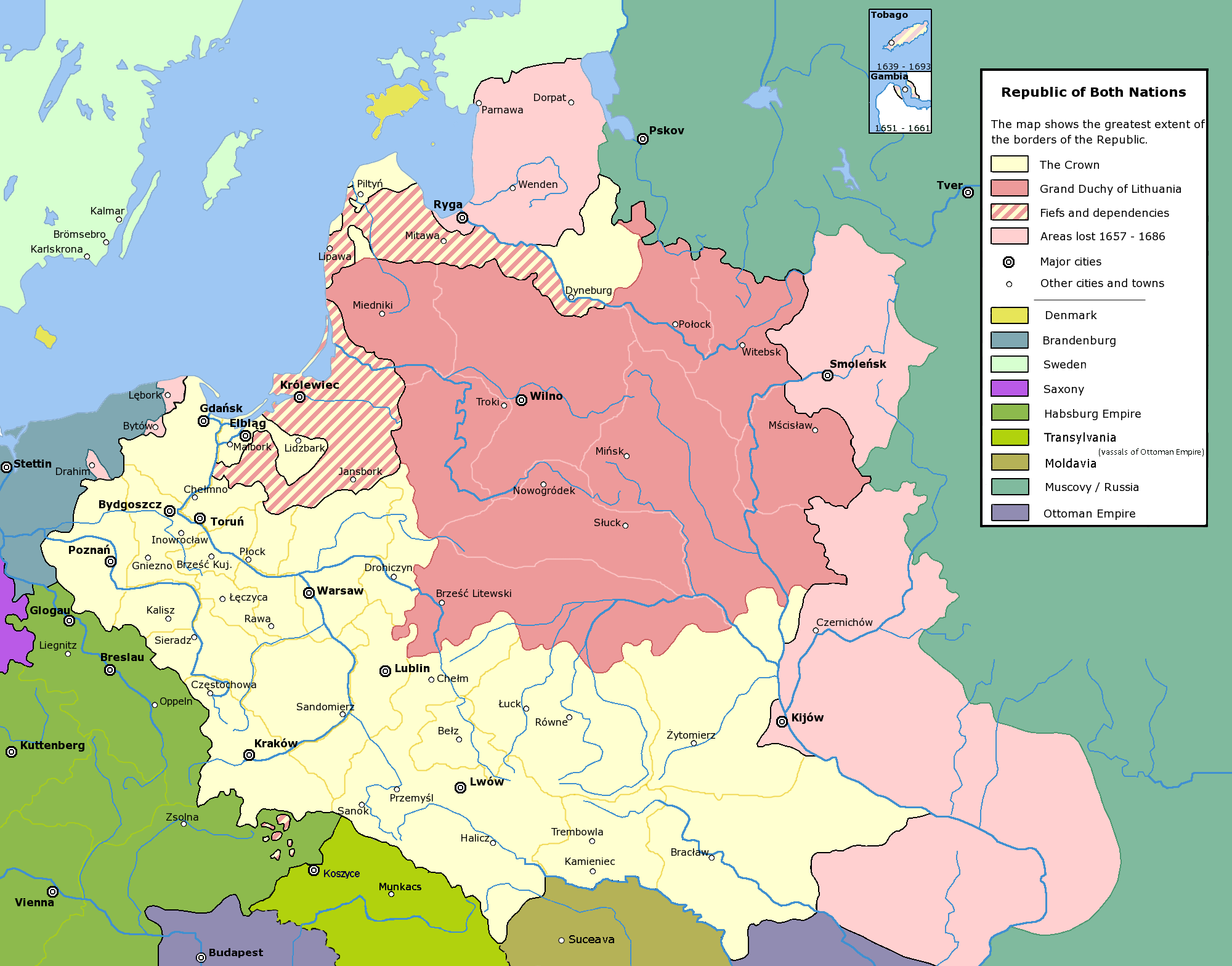 |
| Polish-Lithuanian Commonwealth in times of Saul Wahl life Source: https://upload.wikimedia.org/wikipedia/commons/4/43/Rzeczpospolita.png |
In fact, the previous king - Stefan Batory - established in
1580 something rather unique in Europe: Jewish Parliament, called the Convent
of Four Lands (in Polish: Sejm Czterech Ziem, in Hebrew: Waad Arba Aracot).
After that Jews became the second society state after noblemen that had its own
representation. The Convent worked till 1764 when was disbanded because of its
ineffectiveness in collecting taxes.
By that time, the Convent became a top institution of Jewish
self-government in Poland dealing not only with matters of Polish Jews but also
counselling issues of Jewish communities around the Europe. Moreover, they even
established their own court: Tribunal of the Four Lands' Waad (in Polish:
Trybunał Waadu Czterech Ziem), which was the higher instance to Jewish courts
in local communities.
 |
| Documents of Waad Arba Aracot Source: https://upload.wikimedia.org/wikipedia/commons/c/ce/Council4lands.jpg |
It was no revolution when regarding situation of
the Jews - they were under the protection of law since 1264, when the Polish
ruler, Bolesław the Pious, allowed Jewish self-governance and Jewish courts and
gave them several liberties as well (i.e. personal freedom or freedom of
movement). With time they were even given the title of servants to the Treasury
(servi camerae) for they had helped Polish king with raising money.
Also noblemen protected Jews. According to law each nobleman
would lose his nobility after dealing wih trade - in result, many Jews were
asked to deal with trade instead of noblemen. Moreover, in private cities Jews
had even better legal position than in cities that belonged to the king - for
instance while in royal cities they were excluded from municipial powers (they
lived under their own governance), in some private cities they were allowed to
be a members of municipial council.
General overview on Jewish situation in former Poland needs
to be supplied with the fact that, as in any other place in Europe, there were
legaly established Jewish quarters among some Polish cities. But as long as the
Christian part of city used to receive privilege de non tollerando Judaeis,
the Jewish part received privilege de non tollerando Christianis, what
established some kind of equality between both communities. Moreover,
these privileges were not obeyed strictly.
The position of Polish Jews allowed Gavri’el ben Yehoshu‘a
Schossburg, a Hebrew chronicler, to sum it up with words: “a delight to
all the lands of the Exile for its Torah, honor and greatness” (Petaḥ teshuvah, 1651
4a). Unfortunately, that situation had gone with the fall of the
Polish-Lithuanian Commonwealth in 1795, when Germans, Austrians and Russians destroyed and conquered it. But still the memory of former Poland and the
Polish king Saul remained alive among Polish Jews who many times accompanied
Poles during their struggles to regain independence and their own state.
The other side of the coin - the Czech Brethren
'Si non iurabis, non regnabis' (should you not promise, you shall not rule) heard a French prince in the cathedral Notre-Dame in Paris in 1576. It had little to do with France - these words were said by Jan Zborowski who was a member of Polish legacy announcing that the French prince won the election for Polish king. But there was a condition - he had to promise to obey Polish laws including guarenteed religious tolerance. The election agreement also demanded the end of religious wars in France.
Some years later, in 1656 in Lwów Polish king, honoured by the pope with title of rex orthodoxus (orthodox king), entrusted Poland under the Blessed Virgin Mary's protection, whom he announced as The Queen of the Polish Crown. It was almost a copy of similar act made by cardinal Richelieu in France after defeat of his enemies. Since that time Poles started to become more and more fundamental Catholics.
What a change! The questions is: why? And here the issue of Czech Brethren emerges. It was a pacifist social-religious movement that used Arian theology what was the reason why its members were hated and persecuted by Catholics and Protestants in equal measure. Forced to flee from Bohemian kingdom they found the shelter in Poland where they were even allowed to run their own university: the Racovian Academy (1602-1638).
But in times of religious madness the state of tolerance wasn't what they wanted. Under leadership of Jan Amos Komenský they participated in organising Swedish invasion on Poland later known as "deluge". During that war Polish state actually disappeared (king was forced to leave the country). At the same time Poland was attacked by Sweden and Prussia-Brandenburgia (Luteran states), Russia and Ukrainian Cossack (Orthodox Christians), Transylvania (representing Arianism) and Polish Calvins. Aim of all these people was the same - to create their own, intolerant state in which their religion is the ruling one. No one wanted the State of Golden Freedom as Poland was called in that time.
The only Polish neighbour that did not participate in that war was Austria, which was Catholic. Among long list of people who betrayed the Poland there is only one who was Catholic - the rest was of other religion. Somehow (some say it was miracle - the turning point was siege of Częstochowa Monastery) Poland managed to win this war, but it was fatally wounded and its agony lasted over a hundred years untill 1795 when Polish state was finally destroyed by Germans, Austrians and Russians.
Since "deluge" many Poles believe (even now) that a true Pole has to be Catholic and non-Catholic Pole has to be a traitor. Since that time traditional Polish tolerance started to cease.

I found the story really interesting, I'd never heard about it before! It was a bit long, but I'm glad you included this historic perspective!
ReplyDeleteWell I am really shocked! This is a part of the history of Poland that I didn't really know! You taught me a lot of things today! Maybe the post was a bit too long but I appreciated the details!
ReplyDeleteI appreciate the general and historically overview on the Jewish situation in Poland as I really learned something new! Even though it is a bit too long to read and with plenty of details. Anyway good job!
ReplyDeleteThanks for comments! I am glad you enjoyed my text and I promise - next time I will try to write briefly.
ReplyDeleteHey guys, I like the fact you started with a legend then going through history. I have been in Poland once, so I appreciate to know also a little bit of history of your beatiful country. Unfortunately I agree with Nicola, it's a little bit too long, anyway good job.
ReplyDeleteI agree that it was a bit long, but it was certainly interesting.
ReplyDelete